
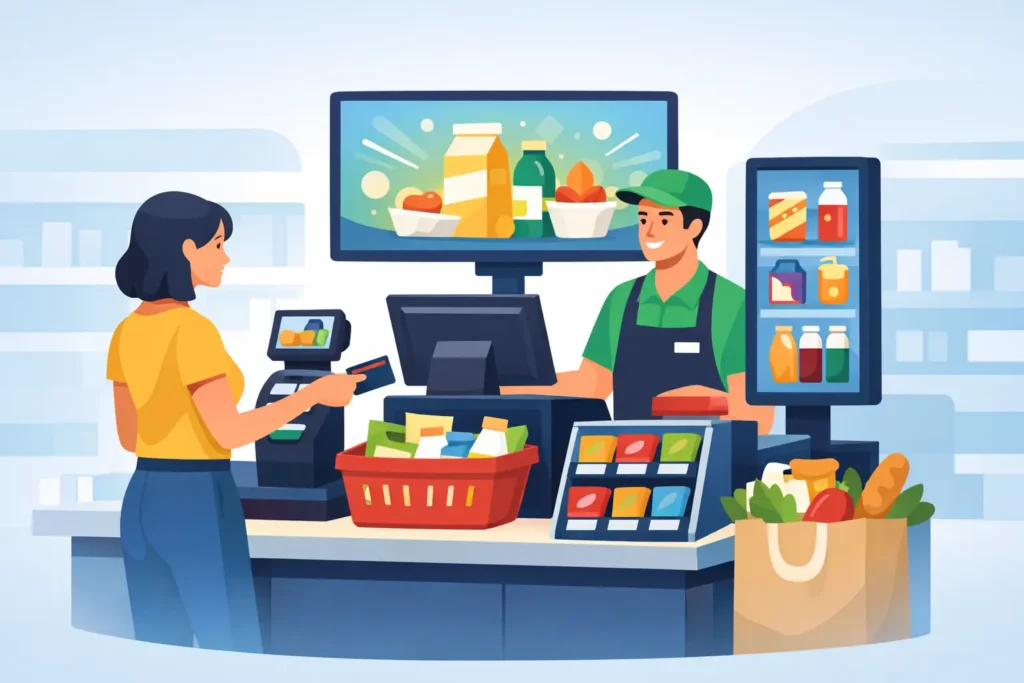
The front end of a supermarket does more than process transactions. It sets the pace for customer flow, captures last-minute purchases, and shapes how organized the store feels at the point where every shopper must stop. That is why supermarket checkout display solutions deserve the same planning attention as gondola shelving, promotional ends, and perimeter merchandising.
A poorly planned checkout area creates friction fast. Queues feel longer, small products get lost in visual clutter, and staff work around fixtures that were never designed for real traffic patterns. A well-designed checkout zone does the opposite. It presents the right products at the right height, keeps lines moving, and makes the final few feet of the shopping journey commercially productive.
What supermarket checkout display solutions need to achieve
At checkout, space is limited and traffic is constant. Displays in this zone have to work harder than standard store fixtures because they serve merchandising, organization, and operational control at the same time.
The first goal is impulse conversion. Products near the till should be easy to recognize in a few seconds, simple to pick up with one hand, and priced in a way that requires little consideration. Confectionery, travel-size items, batteries, gift cards, personal care accessories, and small seasonal products often perform well here because they match quick decision behavior.
The second goal is queue management. Checkout displays should support order rather than create obstacles. If fixtures are too deep, too tall, or placed without enough clearance, they interrupt circulation and make the front end feel congested. This matters even more in compact urban stores, convenience-led supermarket formats, and high-volume grocery locations where every inch at the register affects throughput.
The third goal is durability. Front-end displays take repeated contact from carts, baskets, and shoppers. Lightweight units may be easier to move, but they are not always the right choice for high-traffic lanes. Material selection, base stability, edge protection, and ease of cleaning all affect long-term performance.
Choosing the right supermarket checkout display solutions
There is no single fixture that suits every checkout area. The right selection depends on lane width, store format, product mix, and whether the front end is designed for cashier-assisted checkout, express lanes, or self-checkout.
Countertop displays for high-margin small items
Countertop units are a practical choice when space around the lane is tight but the payment counter still offers usable display area. They work best for compact products with strong packaging visibility, such as gum, mints, pocket tissues, lip balm, small electronics accessories, and promotional packs.
The trade-off is capacity. Countertop displays are excellent for focused merchandising, but they do not hold enough stock for fast-selling lines unless replenishment is frequent. They also need careful placement so they do not interfere with payment terminals, bagging, or cashier movement.
Queue-line displays for dwell-time selling
Queue-line fixtures are designed to capture attention while customers wait. These can include narrow shelving runs, modular basket units, or rail-based displays positioned along the approach to checkout. They are effective because they engage shoppers before they reach the payment point, when there is still time to browse.
Their success depends on width and sightlines. If the fixture narrows the path too much, it can make queues feel uncomfortable. If it is too tall, it can reduce visibility across the front end and create a cluttered impression. In most cases, lower-profile modular units perform better than oversized freestanding displays.
Side-of-checkout and end-of-lane fixtures
The side panels and ends of checkout counters are often underused. These surfaces can support acrylic pockets, hanging systems, slim shelves, or branded side racks for lightweight impulse products. This approach is especially useful when the checkout counter itself has limited usable top space.
These fixtures work well for promotional rotation and branded partnerships, but they need to be integrated cleanly. Improvised add-ons tend to look temporary and wear out quickly in high-contact areas.
Freestanding bins and basket displays
Freestanding dump bins and basket displays can still be effective at checkout, especially for promotional confectionery, mini toys, or seasonal packaged goods. They are useful when stores need flexibility and want to refresh front-end offers regularly.
Still, they are not ideal for every lane. In stores where circulation is already tight, freestanding units can create blockage and reduce the perceived order of the checkout zone. They are better suited to wider queuing areas or waiting zones just before the tills rather than directly beside the cashier station.
Product selection matters as much as fixture selection
Even the best fixture underperforms if the product mix is wrong. Checkout merchandising should be based on speed of decision, ease of carry, and margin contribution.
Products with complicated messaging usually struggle here. Shoppers in line are not comparing technical features or evaluating large pack formats. They are reacting to convenience, habit, value, and visibility. That is why the most effective checkout assortments are usually small, recognizable, and immediately understandable.
It also helps to think in missions. A supermarket serving office workers may perform better with snacks, drinks add-ons, and travel essentials. A family-led hypermarket may find stronger results with confectionery, novelty items, and low-cost seasonal products. In pharmacy-led grocery concepts, health, hygiene, and everyday emergency items often make more sense than broad snack-heavy assortments.
Design details that improve performance
Small design decisions at checkout have an outsized impact because shoppers spend only a short time engaging with these displays.
Clear front-facing presentation is essential. Peg hooks can work for some lines, but open-front bins, gravity-feed systems, and angled shelves often create better visibility for quick-pick items. Price communication should be immediate. If the customer has to search for pricing, the opportunity is often lost.
Fixture height also matters. Products placed too low are easy to ignore, especially when shoppers are focused on unloading baskets or managing children. Products placed too high can feel disconnected from the queue. Mid-level presentation near hand reach generally performs best.
Modularity is another advantage. Retailers rarely keep the same front-end assortment all year. Seasonal campaigns, Ramadan promotions, back-to-school periods, holiday gifting, and supplier-funded activations all require display systems that can be reconfigured without replacing the entire setup.
Material choice should match traffic intensity. Powder-coated metal, durable acrylic components, and reinforced shelving elements are better suited to demanding front-end use than decorative fixtures that prioritize appearance over lifespan. In commercial grocery environments, appearance matters, but not at the expense of function.
Checkout flow, security, and store standards
Front-end merchandising should never compromise checkout operations. This is where many projects go wrong. A display may look attractive on plan, but if it interferes with scanner access, bagging space, customer movement, or staff sightlines, it becomes a cost rather than a sales tool.
Security is another practical concern. Small, high-value items displayed at checkout can be vulnerable to shrink if they are not positioned correctly. Controlled-access display options, cashier-visible placement, and selective use of locking or monitored accessories can reduce risk without removing the sales opportunity entirely.
Consistency matters as well, especially for supermarket groups and multi-location operators. Standardized supermarket checkout display solutions make store rollouts easier, support cleaner visual merchandising, and simplify replenishment planning. That does not mean every store should be identical. It means the fixture system should be flexible within a controlled format.
When custom solutions make more sense
Off-the-shelf fixtures are often the fastest route for common checkout requirements, but custom or semi-custom solutions can be the better investment when stores have unusual lane dimensions, branded program requirements, or a need to integrate signage, storage, and merchandising into one unit.
This is common in new fit-outs, premium grocery concepts, and refurbishments where the front end has to align with a broader store design language. In these cases, a supplier with experience across shelving, signage, acrylic fabrication, and merchandising hardware can help avoid a piecemeal result.
For project buyers, that matters. The best outcome is rarely just a display that fits. It is a front-end solution that works commercially, survives daily use, and remains easy to maintain across multiple stores. That is where consultative supply has real value, especially for retailers and contractors balancing budget, lead time, and operational demands.
JS Retail Displays supports these kinds of decisions by helping buyers match fixture type to store format, product category, and front-end space constraints rather than treating checkout as an afterthought.
A better checkout starts with practical planning
Supermarket checkout display solutions work best when they are planned around real behavior, not just available floor space. The right fixture should support impulse sales without slowing the lane, strengthen presentation without adding clutter, and stand up to heavy daily use. When the checkout zone is treated as a working retail asset instead of leftover space, it starts delivering what every supermarket wants from the front end – better flow, better visibility, and better sales per square foot.