
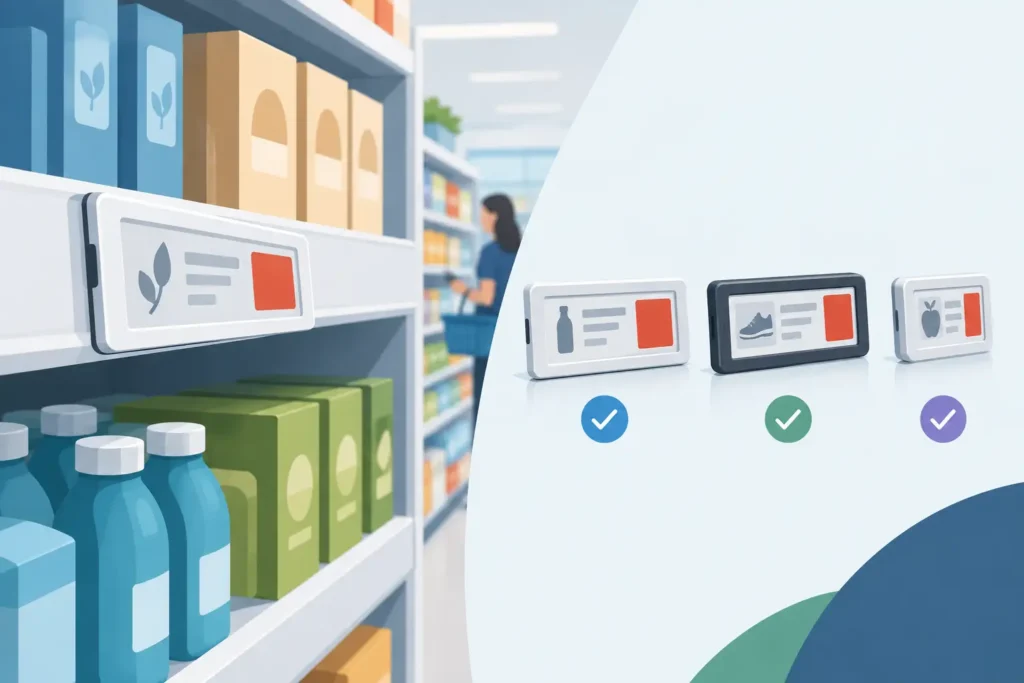
A useful electronic shelf labels comparison starts on the sales floor, not with the screen specification. A grocery operator may need thousands of labels updated quickly during promotions. An electronics retailer may need richer product information and clear pricing for high-consideration items. The right system is the one that supports pricing accuracy, staff productivity, and a cleaner shelf presentation without adding avoidable complexity to the store.
Electronic shelf labels, often called ESLs, replace printed shelf-edge tickets with digital displays connected to a central management platform. They can reduce manual ticket changes, improve price consistency between shelves and point of sale, and give stores more control over promotional messaging. However, display technology, network design, integrations, and mounting hardware vary significantly. Buyers should compare the complete operating system, not just the unit price of an individual label.
Electronic Shelf Labels Comparison: What Actually Changes
Most ESL solutions perform the same basic job: they show a product price and product information at the shelf. The differences become clear when a retailer needs to update thousands of items, run time-sensitive promotions, manage multiple locations, or maintain labels around refrigeration, high traffic, and frequent planogram changes.
A basic system may display price, unit price, barcode, and a promotion icon. A more advanced option can show stock alerts, QR codes, product ratings, nutrition information, or campaign graphics. More features can improve shopper communication, but they also affect label cost, battery consumption, data requirements, and the work needed to maintain accurate content.
For most grocery, pharmacy, and convenience applications, reliability and fast price updates carry more value than a highly detailed display. For consumer electronics, specialty retail, and showroom environments, a larger graphic label may justify the additional investment because it supports product comparison at the point of decision.
Compare Display Technologies by Store Requirement
E-paper labels
E-paper is the most common display technology for electronic shelf labels. It is highly legible under store lighting, uses very little power when the image remains unchanged, and generally offers long battery life. Black, white, and red displays are widely used for standard pricing and promotion flags. Some systems also offer yellow or additional colors.
This option suits supermarkets, grocery aisles, health and beauty shelves, and high-SKU retail areas where clear price communication is the priority. E-paper does not need constant power to retain an image, which makes it practical for long deployments. Its limitation is refresh speed and color capability. It is not designed for moving content or video-like visual effects.
LCD labels
LCD shelf labels can offer sharper color and faster refresh behavior in certain formats. They may be appropriate for electronics displays, premium product bays, or locations where visual content changes frequently. They can also support a more dynamic product presentation than a conventional e-paper label.
The trade-off is usually power consumption. LCD solutions may require more frequent charging, wired power, or a planned battery-management process. They should be selected where their visual capability has a clear merchandising purpose, rather than applied across every shelf by default.
Full-color and graphic labels
Full-color ESLs can make promotional areas easier to identify and allow retailers to use brand colors, images, and clearer campaign messaging. They are particularly useful for endcaps, seasonal displays, fresh food counters, and high-margin categories where presentation influences purchase decisions.
They are not always the best choice for standard shelf runs. Full-color models typically cost more than monochrome or limited-color labels, and a large rollout can increase the project budget quickly. A mixed-label strategy is often more commercial: use standard labels for core shelving and larger color displays where promotion, product education, or brand visibility calls for it.
Connectivity and Coverage Matter More Than They Seem
An ESL system relies on a communications network, commonly using low-power radio technology with access points or gateways installed across the store. The network must reach every label location, including refrigerated cases, back-wall shelving, endcaps, and remote promotional fixtures.
Do not assess connectivity only from a store floor plan. Metal shelving, refrigeration equipment, dense product stock, ceiling height, and building materials can affect signal quality. A proper site survey should determine gateway placement, coverage gaps, installation access, and the capacity required for the number of labels being deployed.
Retailers should also ask how the system behaves if the network connection is interrupted. Labels should continue showing their last approved information, while the platform should provide clear status reporting once connectivity returns. For multi-store chains, centralized monitoring is valuable because it helps teams identify offline gateways, low batteries, or failed updates before a store team discovers the issue at the shelf.
Integration Is the Core of Price Accuracy
The display is only as accurate as the data feeding it. An ESL platform should connect reliably with the retailer’s point-of-sale, pricing, ERP, product information, or promotional management systems. The exact integration path depends on the existing technology stack, but the goal is consistent: the shelf price must reflect the approved selling price at the right time.
During comparison, confirm whether the supplier supports standard APIs, file-based imports, scheduled updates, and real-time price changes. Ask how product records are matched to labels, how exceptions are flagged, and who can approve or reverse an update. A system that updates prices quickly but lacks clear controls can create as many operational concerns as it solves.
This is especially relevant for promotion-led stores. If a weekend offer starts at a defined time, the label update should align with checkout pricing and campaign signage. If a promotion is withdrawn, staff should not need to walk the aisles replacing paper tickets under time pressure. The value of ESLs comes from controlled execution, not simply from replacing printed labels.
Battery Life, Mounting, and Daily Store Use
Manufacturers often quote battery life in years, but actual performance depends on label size, display type, update frequency, operating temperature, and the use of LEDs or other attention features. A label that receives occasional price changes will consume less power than one used for frequent flash promotions and daily content updates.
Ask for battery-life estimates based on your intended update schedule, not a generic maximum. Also ask whether batteries are replaceable, how low-battery alerts are reported, and what labor is needed for replacement across a full estate. A long quoted battery life has less value if the system provides poor visibility into battery status.
Mounting should be treated as part of the ESL comparison, not an afterthought. Labels need compatible shelf rails, clips, adapters, hooks, and sign holders for each fixture type in the store. Wire shelves, glass shelves, refrigerated cases, wooden displays, peg hooks, and produce bins may all need different mounting methods.
A clean installation protects the label, keeps it aligned with the product, and allows staff to reset planograms without damaging the display or leaving loose fixtures behind. Retailers planning new shelving, shelf merchandising components, or a full store refresh should coordinate ESL mounting requirements early in the fixture specification process.
Total Cost Is More Than the Label Price
A lower-priced label can become the more expensive choice if it requires difficult installation, limited integration, frequent battery service, or a costly software model. Compare the complete project cost across a realistic deployment period, including hardware, gateways, mounting accessories, installation, software licensing, integration work, training, support, replacement stock, and battery maintenance.
It is also sensible to calculate the operational return. Stores with frequent paper ticket changes may recover labor hours quickly. Retailers with changing promotions may see fewer pricing discrepancies and better campaign execution. Stores with stable pricing and a limited number of SKUs may still benefit from ESLs, but their payback period can be longer.
Pilot projects are useful when the business case is uncertain. Test a representative department rather than a simple display area. Include normal price changes, promotional events, replenishment activity, store cleaning, refrigeration exposure, and planogram revisions. The pilot should show how the system performs under actual store conditions, not only how it looks on an ideal shelf.
Selecting the Right ESL Configuration
The best configuration is rarely a single label size and one display type across an entire store. Small labels can suit dense grocery shelves, medium formats can improve readability for larger packs, and oversized labels can support feature bays or product education. The same principle applies to color: use it where it directs attention or clarifies an offer, not merely because it is available.
For a practical procurement decision, define the product categories, update frequency, required integrations, fixture types, and rollout scale before requesting proposals. Then compare suppliers against the same scope. This prevents an attractive initial quotation from omitting the gateways, mounts, software functions, or implementation support the project actually requires.
A well-planned ESL deployment should make pricing easier to manage and shelves easier to shop. When label technology is matched to fixture design, store operations, and merchandising priorities, it becomes a working part of the retail environment rather than another system for staff to manage. JS Retail Displays can help project teams consider the shelf-edge display and mounting requirements alongside the wider fixture and merchandising specification.