
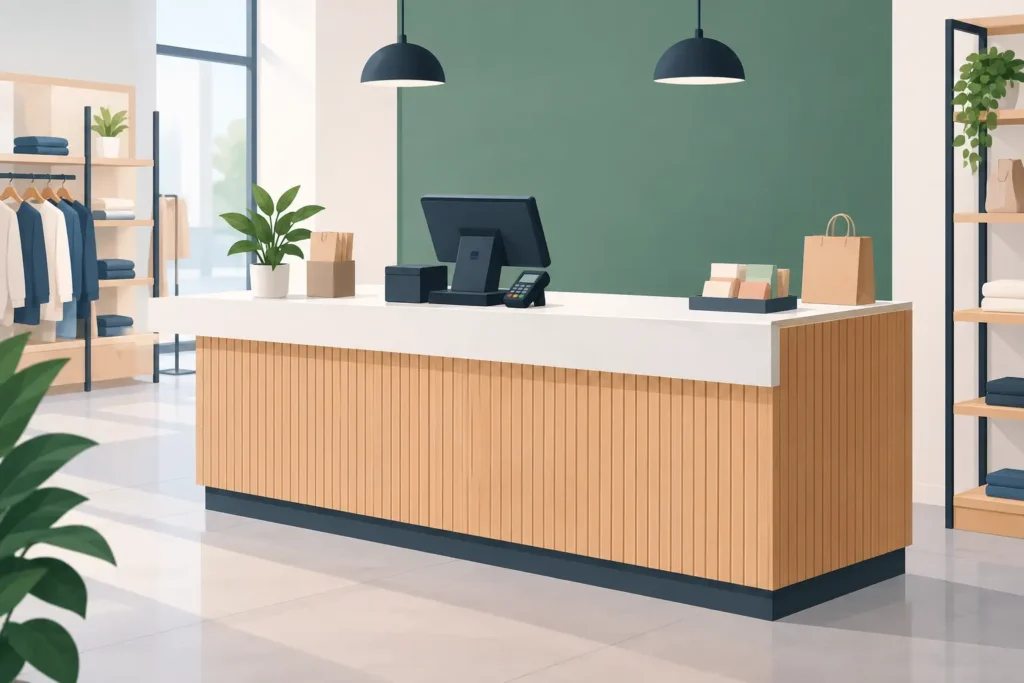
The checkout is where the store’s layout, service standards, security controls, and merchandising strategy meet. A well-planned counter reduces friction for staff and customers while creating a final opportunity for profitable add-on sales. This guide for cash wrap design helps retail operators, fit-out teams, and store planners specify a checkout area that works reliably during everyday trading.
Start With the Cash Wrap’s Job
A cash wrap is more than a counter with a POS terminal. It is a working station for payment, bagging, returns, customer questions, receipt handling, packaging, and often loss-prevention procedures. In smaller stores, it may also serve as the main service desk. In larger supermarkets or specialty chains, it needs to support a defined checkout process without blocking the queue or distracting from customer service.
The right design begins with the store format. A fashion boutique may prioritize a refined front-facing counter with concealed storage and a small impulse display. A grocery or convenience store needs faster transaction handling, durable work surfaces, scanner placement, bagging capacity, and clear queue organization. Electronics retailers often require protected space for high-value accessories, warranty paperwork, and secure collection of online orders.
Define the operational role before selecting finishes, display accessories, or counter dimensions. Attractive joinery cannot compensate for a counter that leaves no space for bags, receipt printers, cable management, or staff movement.
Plan the Location Around Customer Flow
Cash wrap placement affects the way shoppers move through the entire sales floor. Most stores position the counter near the exit so customers can complete payment without retracing their path. However, the counter should not create a bottleneck at the entrance, obstruct sightlines, or force customers to pass through a crowded queue just to leave the store.
Consider how customers approach the counter, wait in line, pay, collect their items, and exit. Each stage requires adequate clearance. A poorly positioned counter can cause lines to spill into aisles, block promotional fixtures, and make the store feel disorganized even when the rest of the retail environment is well planned.
For high-traffic locations, use queue barriers, floor guidance, or low-profile merchandising units to define the waiting area. The goal is to make the route obvious without turning the entrance into a maze. The counter should also provide staff with clear views of key areas, particularly entrances, high-value displays, and blind corners.
Size the Counter for the Actual Transaction
Counter size depends on transaction volume, product size, staffing, and the equipment used. A compact counter may be appropriate for a low-volume specialty retailer, but it can quickly become inefficient if staff must process returns, gift wrapping, or multiple payment types. Grocery operators should allow practical space for scanning, bagging, and customer packing, while stores selling larger boxed products may need a separate collection or packing point.
Ergonomics matter on both sides of the counter. Staff should be able to reach the POS screen, scanner, receipt printer, cash drawer, bags, and frequently used supplies without repeated twisting or stretching. Customers need a clear payment point that accommodates card, contactless, and mobile payments. If the counter is too deep, communication becomes awkward. If it is too shallow, equipment and merchandise compete for the same surface.
A two-level design can help where presentation and operations have different needs. The customer-facing side can maintain a clean branded finish, while the staff side provides a practical worktop and storage zone. This approach is especially useful when cable runs, payment devices, and back-office supplies need to remain out of sight.
Build in Storage, Power, and Service Access
The most common cash wrap design problem is insufficient back-of-counter storage. Daily supplies accumulate quickly: bags, labels, paper rolls, packaging, cleaning materials, spare devices, paperwork, and seasonal promotional stock. Without dedicated compartments, staff place these items on the counter or store them in unrelated display areas, weakening both efficiency and presentation.
Specify closed cabinets or drawers for operational supplies and reserve accessible shelving for items used repeatedly during transactions. Lockable compartments are advisable for cash handling, controlled merchandise, documents, and staff belongings. In categories with small, high-value products, secure under-counter storage can support controlled replenishment without sending employees away from the checkout.
Power and data access should be planned early, not added after installation. POS systems, card terminals, barcode scanners, receipt printers, digital customer displays, chargers, and security devices all need organized connections. Concealed cable management keeps the workstation safer and more professional, while accessible service panels make maintenance easier. For projects in leased units or malls, confirm the available electrical and data points before finalizing the counter layout.
Treat the Cash Wrap as a Merchandising Zone
The checkout area is valuable selling space, but only when merchandise is relevant, easy to shop, and kept under control. Impulse displays should support fast decisions rather than create visual clutter. Small accessories, seasonal items, refill products, gift cards, batteries, travel sizes, or low-price essentials often perform well because they answer an immediate need.
Product choice depends on the retail category and the customer’s reason for visiting. A supermarket may use the zone for snacks, drinks, and everyday essentials. A fashion retailer may feature socks, belts, fragrance, or care products. An electronics store may present cables, chargers, screen protection, or small connectivity accessories. The display should feel like a logical extension of the basket, not an unrelated clearance area.
Use shelf trays, acrylic holders, countertop risers, or compact peg displays to keep products faced up and easy to replenish. Price communication must be simple. Customers should not have to ask a cashier for the price of a small add-on item, especially during busy periods.
There is a trade-off between selling capacity and transaction speed. Filling every available surface may increase assortment, but it can reduce room for bags, receipts, and customer interaction. Keep the payment point clear and protect the staff work zone from promotional overflow.
Select Materials for Daily Commercial Use
Cash wraps receive constant contact from carts, bags, products, cleaning chemicals, payment devices, and staff activity. Material selection should reflect the environment, not only the initial visual concept. Laminated boards, metal details, solid surfaces, tempered glass, acrylic components, and durable edge finishes each have a place depending on the retail format and budget.
For grocery, convenience, and high-traffic retail, prioritize impact resistance, easy cleaning, and replaceable components. Darker finishes may hide minor marks but can show dust and fingerprints. Light finishes can brighten a small store but may require more frequent cleaning. In premium environments, a higher-end finish can strengthen brand perception, provided the counter still has practical protection at corners and high-contact areas.
Branding should be visible but disciplined. A front panel, illuminated logo area, changeable poster holder, or digital messaging screen can reinforce the store identity without overwhelming the checkout. If promotions change frequently, use modular graphic holders rather than applying permanent graphics that become outdated.
Design for Security Without Making Service Feel Hostile
The cash wrap is a natural control point for retail security. It can support supervision of the entrance, management of returns, monitoring of small high-value products, and proper handling of cash or transaction documents. Design features such as lockable drawers, secured storage, cable protection, and controlled access to staff areas should be considered from the start.
At the same time, avoid turning the counter into a physical barrier that makes customers feel unwelcome. The strongest checkout designs balance visibility and control with approachable service. Low, organized displays and clean counter lines can improve oversight while maintaining an open retail atmosphere.
For stores using electronic article surveillance or other anti-theft systems, ensure the checkout process allows staff to deactivate or remove security tags efficiently. The position of tag detachers, scanners, and bagging space should be coordinated so employees do not need to reach across customers or interrupt the transaction flow.
Specify a Counter That Can Adapt
Retail operations change. Payment technology evolves, product ranges shift, and promotional programs move with the season. A fixed counter with no room for new equipment or revised merchandising can become a costly limitation. Where possible, specify modular shelves, adjustable display components, replaceable graphic panels, and flexible storage arrangements.
This does not mean every cash wrap needs an elaborate custom build. A standard modular solution may be the more practical choice for multi-store rollouts, tight timelines, or stores with a proven operating model. Custom fabrication is most valuable when the footprint is unusual, the brand presentation is highly specific, or the counter must combine several functions in one compact area.
A reliable cash wrap earns its value one transaction at a time. Plan it around the staff who operate it, the customers who queue at it, and the products that can genuinely sell from it. When those requirements are addressed together, the checkout becomes a controlled, productive part of the retail environment rather than an afterthought at the exit.