
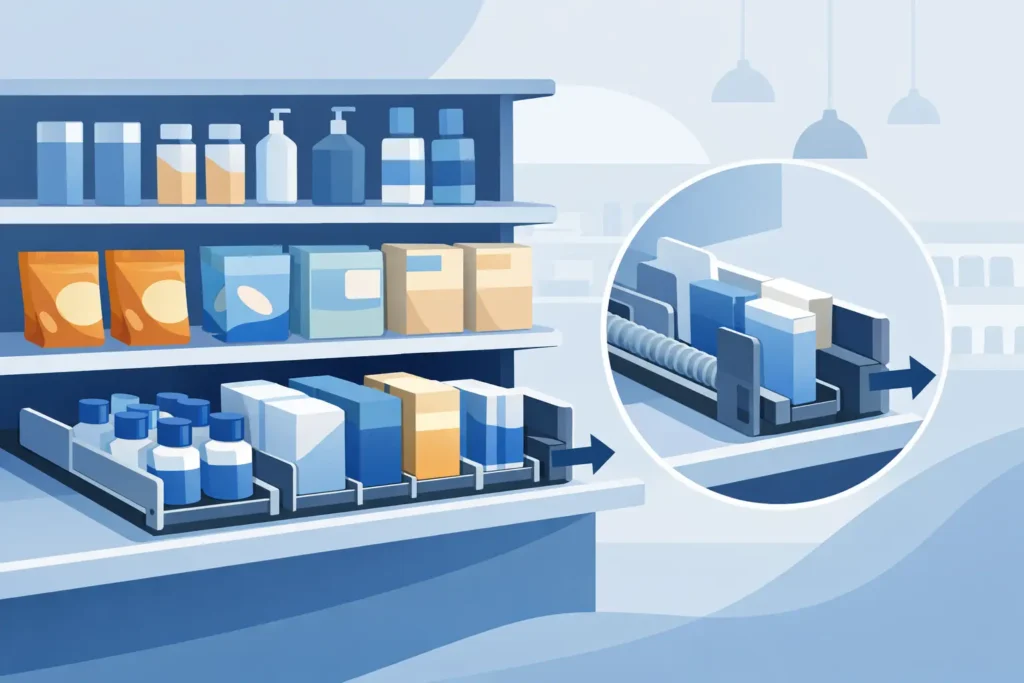
A shelf that looks full at opening can lose its selling power by lunchtime. Fast-moving products are picked from the front, packages fall sideways, and staff spend valuable time recovering shelves instead of serving customers. This guide to shelf pusher systems explains how retailers and fit-out teams can use gravity-fed merchandising to maintain clean product facings, improve rotation, and make better use of every shelf.
Shelf pushers are most effective where products are lightweight to medium weight, regularly replenished, and expected to stay front-facing throughout the day. They are widely used in supermarkets, pharmacies, convenience stores, electronics accessories, and health and beauty categories. The objective is simple: when one item is removed, the next item moves forward in a controlled way.
What Is a Shelf Pusher System?
A shelf pusher system uses a spring-loaded pusher, a product tray or base, and side dividers to keep merchandise aligned and positioned at the shelf edge. The pusher applies measured pressure from behind the product, advancing the remaining stock as customers remove items.
The system can be installed on existing gondola shelving, metal shelves, wire shelves, or purpose-built display fixtures, depending on the mounting method. Some configurations are designed as complete trays, while others use individual pushers and dividers that adapt to the retailer’s current shelf format.
For customers, the result is an orderly display with accessible products. For store teams, it reduces manual facing and helps preserve a consistent planogram. For category managers, it can protect visibility for products that are easily lost at the back of a shelf.
A pusher system does not create demand by itself. It supports the conditions that help a shopper find, understand, and select a product quickly. That distinction matters when evaluating the investment. The strongest results usually come when pushers are combined with clear shelf-edge labeling, logical product grouping, and a replenishment routine that keeps stock available.
Guide to Shelf Pusher Systems: Main Components
The right system starts with understanding what each component does. A complete setup may include a front rail or fence, dividers, pusher units, trays, adapters, and shelf tickets. Not every application needs every component.
Spring-loaded pushers
The pusher is the working part of the system. Its spring tension should suit the product weight, pack depth, and number of units held in a lane. Too little tension allows products to stop short of the shelf edge. Too much tension can make removal difficult, cause lightweight packs to tilt, or place unnecessary pressure on soft packaging.
Pusher force is not a one-size-fits-all decision. A small cosmetics carton requires a different setting from a row of canned goods, bottled supplements, or boxed mobile accessories. Where ranges include several pack sizes, adjustable pusher systems offer more flexibility than fixed-force units.
Dividers and lane control
Dividers separate products into defined lanes. They prevent neighboring SKUs from mixing, control the width of the display, and support a clean vertical presentation. Transparent dividers are especially useful when product packaging, color coding, or branding should remain visible from the side.
Divider height should be selected carefully. Low dividers make products easy to pick up but may not contain tall or unstable packs. Higher dividers improve control for narrow bottles and flexible pouches, although they can make a compact shelf feel more enclosed.
Trays, bases, and mounting options
Tray systems provide a dedicated base for each product lane. They are often the practical choice for shelves with uneven surfaces, open-wire decks, or situations where a retailer wants a more controlled and repeatable installation. Individual pusher and divider components can be a better fit where shelf dimensions vary or where layouts change frequently.
Mounting compatibility must be checked before ordering. Adhesive, magnetic, clip-on, rail-mounted, and screw-fixed solutions each have a place. Adhesive systems can support a clean retrofit but require properly prepared surfaces. Mechanical fixing provides greater security in demanding environments, while rail-based formats can make future resets faster.
Where Shelf Pushers Deliver the Best Return
Shelf pushers are not necessary across every aisle. Their value is highest where product recovery is a recurring labor issue or where a poor-facing shelf weakens the category’s appearance.
Convenience and impulse zones are a common priority. Batteries, chargers, travel-size personal care items, confectionery, gum, and small electronics accessories can quickly become disorganized because shoppers compare and remove individual units. A defined lane and reliable front-facing position make these small products easier to shop.
In grocery and pharmacy environments, pushers can improve presentation for boxed medicines, nutritional supplements, cosmetics, sauces, seasonings, snack bars, and packaged household goods. They can also assist with first-in, first-out rotation when staff replenish from the rear of a properly designed lane. However, rotation only works if the product and shelf arrangement allow rear loading. A standard front-loaded shelf pusher does not automatically solve date control.
High-velocity categories often produce the fastest labor benefit because employees repeatedly face the same shelves. Slow-moving or oversized products may not justify the cost per facing. It depends on product margin, replenishment frequency, the importance of shelf appearance, and the amount of manual recovery currently required.
How to Specify the Right System
Before selecting a shelf pusher system, measure the physical shelf and review the actual product packs rather than relying only on listed dimensions. Packaging changes, tapered bottles, hanging tabs, and soft bags can all affect performance.
A practical specification should confirm these factors:
- Shelf width, depth, material, and front-edge profile
- Product width, height, depth, weight, and package stability
- Number of facings and desired units per lane
- Replenishment method, including whether rear loading is required
- Required pusher force and divider height
- Shelf labels, promotional strips, and price communication requirements
The product depth determines how many units can sit in each lane, but usable capacity is often less than the shelf’s full depth. Allow clearance for the pusher body and sufficient movement so the last unit still reaches the front. For very deep shelves, assess whether a longer tray is practical or whether the category would be better merchandised in two rows.
Product width should be tested with real samples. A lane that is too tight can catch corners and damage cartons. One that is too wide allows packs to rotate and defeats the purpose of the system. As a working principle, aim for controlled movement without forcing the product through the lane.
For retail chains and fit-out projects, standardization is valuable. Using a common pusher platform across comparable bays can simplify procurement, installation, replacement parts, and staff training. Still, standardization should not override product suitability. A premium cosmetics shelf, a grocery condiment bay, and an electronics accessory display may need different forces, divider profiles, and mounting methods.
Installation and Planogram Considerations
A neat installation begins with a clean shelf and a confirmed planogram. Mark the lane positions before fixing components, particularly when several SKUs must align precisely with shelf labels. If a shelf is being reset, install the dividers first, then position the pusher and test travel with a full lane of product.
Test the first, middle, and last units in the row. The first product should be easy for a customer to remove. The middle products should advance without jamming. The final product must remain visible and should not be trapped by an oversized pusher head or front fence.
Planogram discipline is essential after installation. Shelf pushers work best when each SKU has a defined home and staff replenish into the correct lane. If teams regularly place substitute products in empty spaces, the display can become misleading or unstable. Clear shelf tickets and sensible lane widths reduce this risk.
Promotional activity also needs consideration. Short-term offers often involve larger packs, bonus packs, or temporary packaging that may not fit the established lanes. Modular components allow a faster reset, while fixed systems may require more planning. For stores with frequent promotional changes, flexibility can be more valuable than maximum capacity.
Common Mistakes to Avoid
The most common error is selecting based on shelf dimensions alone. A system may fit the shelf perfectly and still fail because the product is too light, too tall, or shaped in a way that causes it to bind. Always test representative packs before committing to a large rollout.
Another mistake is using the strongest available spring to ensure products move forward. Excessive force can make products difficult to remove and can create an untidy rebound when a customer takes an item. Controlled advancement is more important than aggressive pressure.
Finally, do not overlook maintenance. Dust, spilled liquids, broken packaging, and shifted dividers affect performance. Include shelf pusher checks within normal merchandising routines, especially in food retail and high-touch departments.
Measuring Performance After Rollout
A shelf pusher project should be assessed against operational outcomes, not appearance alone. Store managers can compare the time spent on shelf recovery before and after installation, monitor out-of-stock visibility, and review whether products remain correctly faced during peak trading hours.
Customer feedback is also useful. If shoppers struggle to remove a product, the lane may be too tight or the pusher force too high. If the shelf still looks empty despite available stock, the pusher may need adjustment or the replenishment cycle may need attention.
For larger deployments, begin with a pilot in one high-volume category. This gives the project team time to validate product fit, installation time, staff acceptance, and cleaning requirements before specifying the system across multiple stores. JS Retail Displays can support this selection process by matching shelf merchandising components to the fixture type, product range, and operational needs of the project.
The best shelf pusher system is the one that holds its presentation through real trading conditions, not just at the time of installation. Select it around the product, test it with the people who replenish the shelf, and let the display do more of the daily recovery work.