
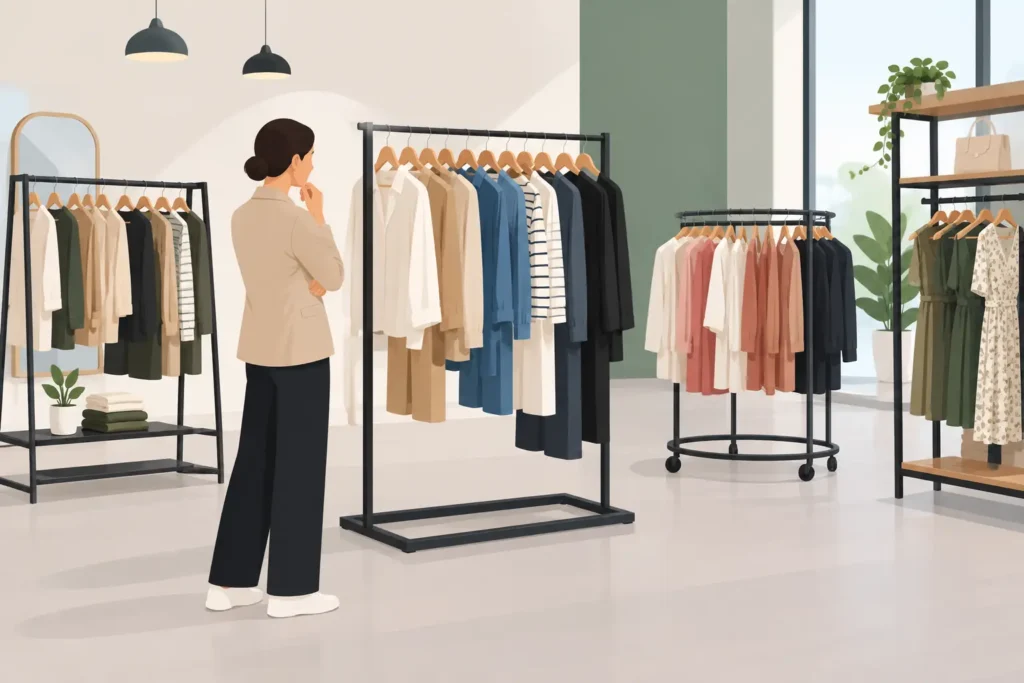
A garment rack can either create a clear, shoppable clothing display or turn valuable selling space into a crowded storage zone. Knowing how to choose garment racks starts with the way customers move through the store, the weight of the merchandise, and the presentation standard your brand needs to maintain. For fashion retailers, outlet operators, department stores, and fit-out contractors, the right rack is a working fixture – not simply a place to hang clothes.
Start With the Retail Purpose of the Rack
Before comparing finishes, wheels, or dimensions, define what each rack must do in the store. A heavy-duty stockroom rack serves a different purpose from a front-of-store display rail. Mixing these roles can lead to cluttered displays, difficult replenishment, and fixtures that wear out before their expected service life.
Sales-floor garment racks should support product visibility and encourage customers to browse. They are commonly used for new arrivals, coordinated collections, promotions, and high-volume apparel categories. Their height, shape, and placement should make the merchandise easy to see without blocking sightlines across the store.
Back-of-house racks need greater load capacity and daily durability. They may hold replenishment stock, prepared customer orders, returns, or garments awaiting steaming and merchandising. In this setting, a practical commercial rail with a stable base is usually more valuable than a decorative fixture.
Temporary or mobile racks are useful for pop-up promotions, seasonal collection changes, fitting-room support, and trade events. Choose these carefully. Mobility is useful only when the frame, casters, and locking mechanism are strong enough for frequent movement under load.
Match the Rack Type to the Merchandise
The product mix determines the rack configuration. Lightweight shirts on slim hangers place far less demand on a fixture than winter coats, formalwear, denim, or heavily embellished garments. A rack that appears adequate when empty may flex, lean, or become difficult to roll once fully loaded.
Straight garment racks are a practical choice for wall-adjacent displays, stockrooms, and linear collection presentations. They use space efficiently and make it easy to organize garments by size, color, or style. They are particularly effective where merchandise needs to face one direction and staff need quick access for replenishment.
Round racks work well for promotional zones and high-volume apparel because customers can browse from all sides. However, they require sufficient circulation space. A round rack placed in a narrow aisle often creates congestion rather than a focal point.
Two-way and four-way racks are suited to fashion floors where visual merchandising matters. They allow multiple product stories or garment types to be presented in one fixture footprint. A four-way rack can display a coordinated outfit program, for example, but it needs disciplined merchandising. Overloading every arm makes the display look like clearance stock.
For long dresses, abayas, coats, and other full-length merchandise, verify the hanging height before ordering. Garments that touch the floor look untidy, become damaged more quickly, and make customers reluctant to browse. Adjustable-height garment racks can be a useful option where seasonal assortments change between short and long apparel.
Measure the Space Before You Buy
Retail fixtures should be selected from a floor plan, not from product photos alone. Measure the intended display area, nearby aisle widths, ceiling height, wall clearance, and the path used for replenishment. Account for the full footprint of the base, not just the hanging rail.
A rack needs space around it for customers to pull garments forward, step back, and pass other shoppers. This is especially relevant in busy promotional areas and compact stores. If two racks create a tight passage when garments are fully stocked, the problem will be more noticeable during peak trading hours.
Consider sightlines as well. Tall or densely loaded racks can hide signage, cash wraps, feature walls, and higher-value merchandise behind them. In many apparel stores, lower fixtures work best in central floor areas, while taller racks can sit against perimeter walls or at the rear of a department.
For multi-location projects, document standard rack positions and dimensions within the store layout. This supports consistent visual presentation across branches and simplifies future fixture replacement or expansion.
Check Capacity, Stability, and Construction
Commercial garment racks must perform under repeated use. Check the stated load capacity, but also assess how the overall frame handles the load. A strong rail is not enough if the uprights, base, joining points, or casters are weak.
Steel construction is a dependable choice for high-traffic retail and stockroom applications. Chrome finishes provide a clean, familiar retail appearance and are easy to coordinate with many store concepts. Powder-coated finishes can offer a more defined brand look, including black, white, or custom color schemes, while helping protect the frame from routine wear.
Pay close attention to the base design. Wide, well-balanced bases reduce the risk of tipping when customers pull garments from one side or when staff move the rack. This is particularly important for four-way racks, tall adjustable models, and racks carrying heavy outerwear.
Welded joints and reliable connection points matter in long-term use. For projects that require frequent assembly, disassembly, or relocation, select a system designed for that purpose rather than treating a fixed display rack as a portable fixture.
Decide Whether Mobility Is Worth It
Casters add flexibility, but they are not automatically the best choice. Mobile racks make floor resets, cleaning, event setups, and merchandise transfers easier. They are often valuable in outlet stores, stockrooms, and retail environments with frequent promotional changes.
The trade-off is that casters can reduce stability if they are undersized or poorly matched to the load. Select commercial-grade wheels with effective brakes, especially for racks placed on polished floors, tiles, or slightly uneven surfaces. Test whether the rack remains steady when customers browse it with the brakes engaged.
For permanent wall-side or department displays, fixed feet may be the better option. They provide a more grounded appearance, reduce movement, and often cost less than a mobile equivalent. The decision should follow the operating routine of the store, not a preference for one style of fixture.
Select a Finish That Supports the Store Concept
A garment rack is part of the visual merchandising system. Its finish should support the clothing rather than compete with it. Chrome is versatile and works well in value fashion, stockroom, and general apparel environments. Matte black creates a stronger contemporary look and can suit premium, streetwear, or boutique concepts. White racks can feel clean and light in children’s wear, resort collections, or minimalist store designs.
Consistency matters more than choosing the most decorative option. If wall shelving, mannequins, sign holders, and garment rails use unrelated finishes, the store can look improvised. Specify a fixture palette early in the fit-out process and apply it across display zones where possible.
Also consider maintenance. Highly polished finishes can show fingerprints, while light-colored painted surfaces may reveal scuffs in high-contact areas. For busy stores, choose materials that staff can clean quickly as part of daily opening or closing routines.
Plan the Rack for Merchandising, Not Maximum Density
The most common garment rack mistake is overfilling it. Buyers often focus on how many units a rack can physically hold, while customers judge whether they can comfortably browse what is in front of them. A tightly packed rail hides colors, creases garments, and makes sizing difficult to identify.
Allow enough spacing for hangers to move easily. This gives products a cleaner profile and helps staff maintain size order. It also leaves room for visual breaks between color groups, product categories, or coordinated collections.
Use garment racks alongside other display components when the range requires more context. Folded knitwear, accessories, footwear, and promotional signage may need shelving, tables, acrylic holders, or poster displays nearby. A rack is most effective when it works as part of a complete retail presentation rather than carrying every product in a category.
Specify for Installation, Replenishment, and Future Changes
For a new store or refit, garment rack selection should involve the people responsible for merchandising and daily operations. A fixture may look suitable on a layout but create problems if staff cannot roll it through a doorway, replenish it efficiently, or clean beneath it.
Confirm delivered dimensions, assembly requirements, packaging, and the number of racks needed by zone. For larger projects, standardizing key rack types can improve purchasing control and make replacements easier when a location expands or a fixture is damaged.
JS Retail Displays supports commercial buyers with garment rack and fashion fixture options selected around product type, store layout, and operational needs. The most effective choice is the one that carries the collection securely, supports the intended brand presentation, and still gives customers a comfortable reason to stop and browse.