
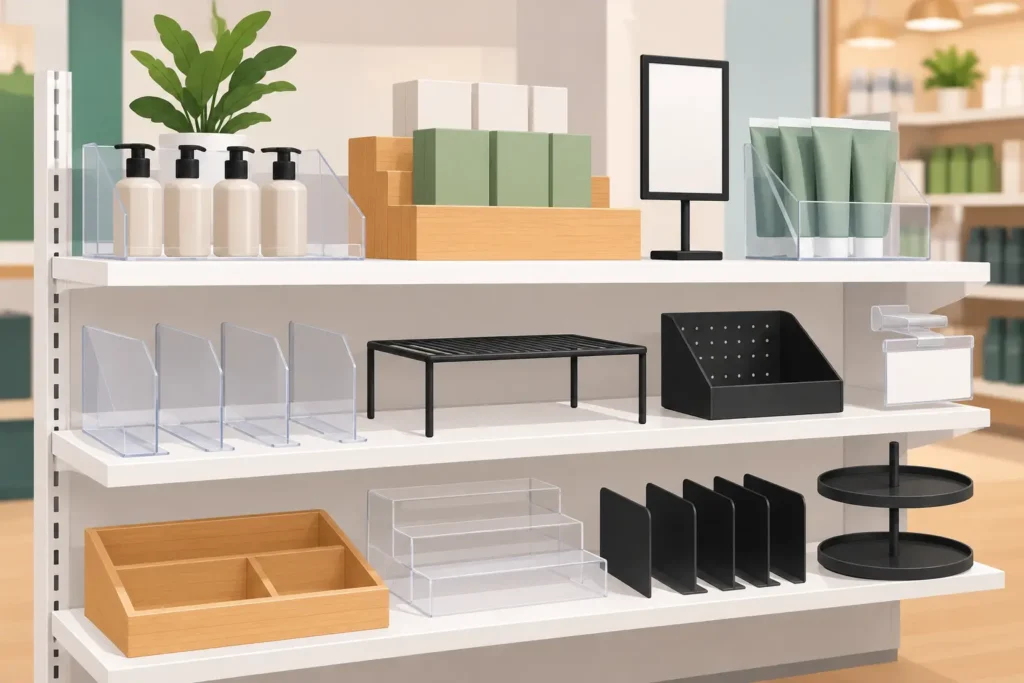
A well-stocked shelf can still lose sales when prices are hard to read, products fall forward unevenly, and promotional messages disappear into visual clutter. The best shelf merchandising accessories solve these practical problems at shelf level, where shoppers make fast comparisons and buying decisions. For supermarkets, pharmacies, electronics stores, convenience retailers, and specialty outlets, the right components create order without sacrificing product visibility or replenishment speed.
This is not simply a matter of adding more plastic parts to a fixture. Each accessory should support a clear retail objective: guide the shopper, protect the product, hold the facing, communicate price, or give priority items more presence. Selecting the right combination starts with understanding the shelf, the category, and the way customers shop it.
Start With the Shelf and Product Category
Shelf merchandising accessories must fit the fixture before they can improve it. Measure shelf thickness, depth, and length, then confirm whether the shelf uses a standard data channel, a wire shelf, a glass shelf, or a perforated metal system. A component that looks suitable in a catalog but does not match the shelf profile can create installation delays and inconsistent presentation across the store.
Product dimensions matter just as much. Small, lightweight items such as cosmetics, confectionery, batteries, and packaged accessories often need containment and forward-facing support. Larger grocery products may need dividers or shelf stops to maintain neat blocks. Bottles, jars, and unstable packs need accessories selected with safety and load distribution in mind.
Also consider the restocking method. High-turnover categories should not use systems that slow staff down during replenishment. A pusher system may improve shelf appearance for fast-moving packaged goods, but it should be sized correctly so staff can refill it quickly without damaging packs or dislodging labels.
Best Shelf Merchandising Accessories by Function
The most effective accessory package usually combines several functions rather than relying on one product. A shelf edge label holder improves price communication, for example, but it may need dividers or pushers beside it to keep the product presentation equally clear.
Shelf Edge Data Strips and Ticket Holders
Data strips and ticket holders provide a dedicated position for shelf labels, product names, barcode information, and promotional pricing. They reduce the risk of loose paper labels, incorrect placement, and pricing information that is difficult for shoppers to find.
Clear, colored, adhesive, magnetic, clip-on, and snap-on formats each serve different fixture types. Clear strips suit standard price labels where the product information should remain the focus. Colored strips are useful for category coding, promotion zones, clearance areas, or store navigation. Clip-on and snap-on options are often better suited to shelves that require regular updates or temporary campaigns.
The key is consistency. A store with mixed label heights, crooked tickets, and damaged strips looks harder to shop, even when the product assortment is strong. Use one label format within each category where possible, and make sure the strip height matches the amount of information required.
Shelf Dividers and Product Separators
Shelf dividers create clear product boundaries. They are especially valuable in grocery, health and beauty, stationery, hardware, and small electronics categories where multiple SKUs share a shelf. Dividers prevent products from mixing, protect facings during customer selection, and make gaps easier for staff to identify.
Fixed dividers offer reliable structure for stable planograms and product sizes that rarely change. Adjustable dividers provide more flexibility for seasonal ranges, changing pack sizes, and promotional displays. For stores with frequent resets, adjustable systems can reduce the need to replace components every time the planogram changes.
Height is an important decision. Low dividers preserve open sightlines but may not control tall or unstable packs. Higher dividers provide better containment, yet they can obscure labels or make products feel boxed in. The right choice depends on the product’s shape, weight, and shopper handling.
Gravity Feed and Shelf Pusher Systems
Gravity feed and pusher systems keep merchandise at the front of the shelf as units are removed. They are highly effective for packaged food, beverages, personal care products, medicines, and small boxed goods. A full-looking shelf improves product availability perception and reduces the visual impact of partial stock.
These systems can also support better stock rotation when installed and replenished correctly. Staff can load products from the back where the fixture design allows, while customers take items from the front. This can be particularly useful in categories with date-sensitive inventory.
However, pushers are not the best answer for every product. They require the correct lane width, pusher strength, and shelf depth. If the spring pressure is too high, lightweight packs may tip or become difficult to remove. If lanes are too wide, products may twist rather than face forward. Test a sample set-up using real merchandise before standardizing across multiple locations.
Shelf Talkers, Sign Holders, and Promotional Frames
Shelf talkers give selected products a stronger voice at the point of purchase. They can draw attention to a new launch, value offer, multi-buy promotion, premium feature, or product benefit without requiring a full display unit. Positioned properly, they interrupt routine shelf scanning and direct attention to the intended item.
Use shelf talkers selectively. Too many promotional flags competing in one bay can make the message less effective and create a cluttered appearance. A good rule is to reserve them for products with a specific commercial reason for extra visibility, such as seasonal offers, private-label campaigns, slow-moving stock, or supplier-funded promotions.
Sign holders and poster frames are useful when the message requires more detail than a shelf label can carry. They work well at category entrances, gondola ends, and higher shelf positions, where shoppers can understand the offer before they reach the product. Choose a format that does not block product access or interfere with aisle clearance.
Shelf Risers, Display Trays, and Acrylic Holders
Some products need elevation rather than containment. Shelf risers create a stepped presentation that makes smaller products easier to see from the aisle. They are effective for cosmetics, accessories, gift items, premium packaged foods, and electronics add-ons where packaging detail affects the purchase decision.
Display trays organize loose or small merchandise into manageable blocks. They help maintain a defined footprint, simplify replenishment, and prevent products from spreading across the shelf. Acrylic holders offer a clean presentation for literature, small boxed products, mobile accessories, and impulse items, particularly where a premium or transparent finish is preferred.
These accessories should be used carefully in high-density stores. Risers and trays improve visibility, but they also reduce usable shelf capacity. In a value-led supermarket category with high volume, capacity may be more important than presentation height. In a premium cosmetics or electronics section, the opposite may be true.
Build a System, Not a Collection of Parts
The best shelf merchandising accessories work as a coordinated system. A practical grocery shelf may combine data strips, dividers, pushers, and a limited number of promotional shelf talkers. An electronics shelf may use acrylic holders, security-aware display solutions, clear price tickets, and risers to separate premium products from entry-level options.
Planogram discipline should guide the final selection. Accessories should reinforce the intended product sequence, brand blocks, price ladder, and promotional zones. If a divider, holder, or sign forces staff to deviate from the planogram, it is not improving the retail operation.
Durability should also be assessed as a commercial factor, not an afterthought. Components in busy retail stores are handled repeatedly by staff and shoppers. Look for materials that resist cracking, discoloration, sharp edges, and loss of grip. Replaceable parts and standardized sizes can make long-term maintenance easier across a chain or multi-site project.
Installation and Maintenance Affect Results
Even high-quality accessories underperform when installation is inconsistent. Align data strips across a bay, keep label positions uniform, and set dividers to the actual product width rather than leaving unnecessary gaps. Promotional holders should be checked regularly so outdated messages do not remain on the shelf after an offer ends.
Assign responsibility for shelf accessory maintenance during routine store walks. Staff should look for damaged ticket holders, missing dividers, empty pusher lanes, loose talkers, and products placed behind the wrong labels. These small corrections protect pricing clarity and preserve a professional store standard.
For fit-out contractors and retail project teams, it is worth specifying accessories early in the fixture schedule. This avoids last-minute compatibility issues and allows the merchandising system to be installed as part of the wider store presentation. JS Retail Displays can support buyers in matching shelf merchandising components to fixture types, product categories, and commercial display requirements.
The right accessory is rarely the most visible one. It is the one that makes the shelf easier to shop, easier to refill, and easier to manage every day – while giving priority products the clear, credible presentation they deserve.