
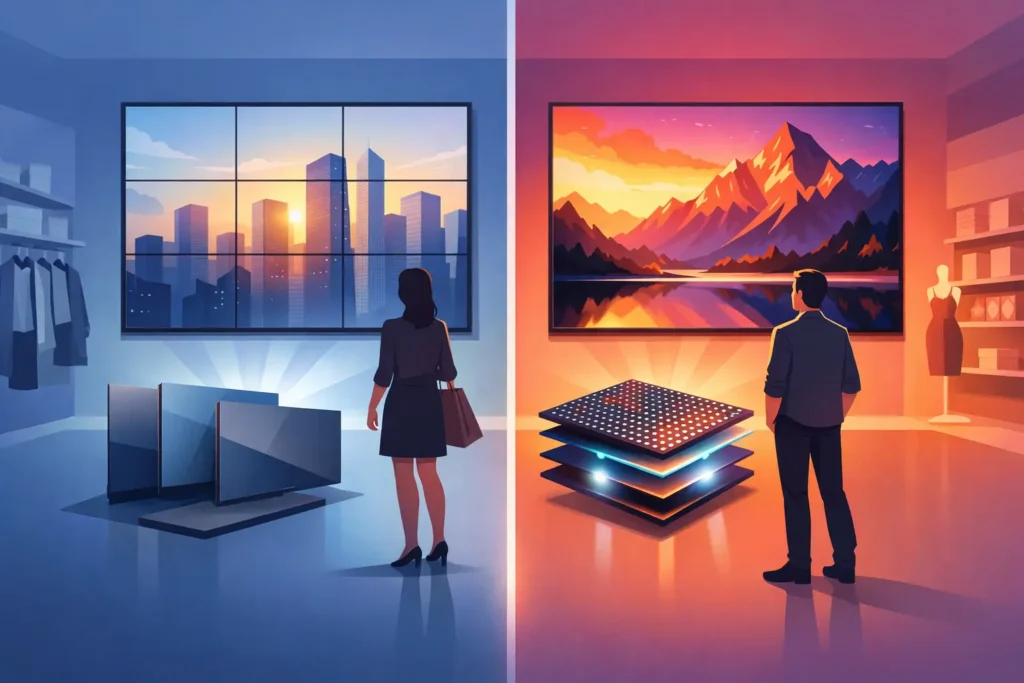
A video wall in a flagship store, supermarket entrance, electronics department, or hotel lobby has one job before any other: make the message impossible to miss. The decision between LCD versus LED video walls affects more than image quality. It determines how much wall space is needed, how close shoppers can stand, how the display performs under ambient light, and what the installation will cost over its working life.
For retail projects, there is no universal winner. LCD video walls remain a practical choice for controlled indoor spaces and close-viewing applications. Direct-view LED walls create larger, more flexible visual canvases with high brightness and fewer visible divisions. The right specification starts with the location, audience distance, content plan, and commercial objective.
LCD Versus LED Video Walls: The Core Difference
An LCD video wall is built by combining multiple commercial LCD panels into one larger display surface. Each panel has a bezel around its edge, so even narrow-bezel models create visible grid lines between screens. The panels are mounted in a video wall configuration and managed through a controller or display management system.
An LED video wall uses individual LED modules to form one continuous display. Rather than arranging complete screens side by side, installers assemble cabinets and modules to the required width and height. This gives LED walls much greater freedom in size, shape, and configuration.
The distinction matters in store design. LCD walls are typically based on standard panel sizes, often 46, 49, or 55 inches. LED can be built around architectural features, fitted to unusually wide counters, wrapped around columns, or scaled across a complete feature wall. However, that flexibility does not automatically make LED the better commercial purchase. The viewing environment decides the value.
When LCD Video Walls Make Commercial Sense
LCD video walls are well suited to indoor locations where customers stand relatively close to the screen. A cosmetics counter, electronics showroom, mall storefront, reception area, or promotional zone may require crisp text, detailed product imagery, and sharp video at close range. Because LCD panels have a high native resolution, they handle fine type and detailed graphics effectively.
For a retailer using product promotions, price messaging, brand campaigns, or digital menus, an LCD wall can provide strong visual performance without requiring a very large installation area. It is also easier to create a predictable design around standard screen dimensions, which can help fit-out teams coordinate millwork, cladding, and wall recesses.
The main limitation is the bezel. Even ultra-narrow bezel displays still show panel joins, especially with light backgrounds, spreadsheets, large product photographs, or content that includes faces. This may not be a concern when the wall is viewed from several feet away or when content is designed around the screen layout. It can be more noticeable in premium fashion, automotive, technology, or hospitality spaces where the display itself is part of the interior statement.
LCD walls also need careful planning for access and alignment. Panels must be mounted precisely to keep joins consistent, and service access should be considered before surrounding finishes are completed. Commercial-grade panels are designed for extended operating hours, but each screen is still an individual component that requires power, signal, and heat management.
Best LCD applications
LCD is often the appropriate choice for a medium-sized indoor wall where content needs to be read closely and the budget needs to remain controlled. It works particularly well for retail promotions, store directories, sales dashboards, menu boards, brand imagery, and product launch zones where a clean rectangular format is sufficient.
Where LED Video Walls Deliver More Value
Direct-view LED is designed for visual impact at scale. Its surface has no conventional screen bezels, allowing video, motion graphics, and large-format brand content to flow across the entire wall. For high-traffic retail environments, this can create a stronger first impression than a panel-based display.
LED walls are especially effective at store entrances, atriums, flagship windows, event spaces, entertainment areas, large supermarkets, and outdoor-facing retail locations. They can achieve higher brightness than typical LCD configurations, helping content remain visible in spaces with strong store lighting, daylight spill, or glazed storefronts.
The technology is also a practical solution when a standard panel grid would not fit the site. A wide wall above a cash wrap, a tall display in a double-height entrance, or a display integrated into a custom feature wall may be easier to specify with LED cabinets. Curved or nonstandard installations are possible with the right product and structural planning.
LED requires a closer look at pixel pitch. Pixel pitch is the distance between LED pixels, measured in millimeters. A smaller pixel pitch produces a finer image for closer viewing, while a larger pixel pitch is suitable when viewers are farther away. If shoppers will stand only a few feet from the display, a coarse-pitch LED wall can look pixelated and may not present small text clearly. In that situation, fine-pitch LED or LCD may be the better option.
LED systems usually carry a higher initial investment, particularly when fine pixel pitch, high refresh rates, premium color performance, and integrated control equipment are required. The trade-off is a more continuous visual surface, greater design flexibility, and strong performance for large-scale content.
Viewing Distance Should Lead the Specification
Many display decisions go wrong because screen size is selected before viewing distance is assessed. A large video wall may look impressive in a drawing but underperform if shoppers stand too close to it. Equally, a small, high-resolution LCD wall may disappear in a large open retail floor.
For close viewing, LCD panels or fine-pitch LED are usually the safer choices. They support detailed product visuals, clear pricing, and readable copy. For a long-distance feature wall viewed across a store, lobby, or concourse, a larger-pitch LED wall can provide better scale and a more efficient use of budget.
Content should be considered at the same time. If the wall will show cinematic campaigns, lifestyle video, and bold graphic motion, LED may provide the strongest effect. If it will display detailed product specifications, promotional pricing, menu information, or multiple content zones, LCD can offer excellent clarity and easier content organization.
Brightness, Operating Hours, and Store Conditions
Ambient light changes the display requirement. A wall installed deep inside a controlled retail space does not need the same brightness as a window-facing installation exposed to daylight. Over-specifying brightness can increase cost and power consumption; under-specifying it leaves the content washed out when it matters most.
Retailers should also confirm operating hours. A display used during standard store hours has different demands from one running continuously in a transit hub, hotel reception, or 24-hour supermarket. Commercial displays are built for sustained use, but the product specification should match the operating schedule rather than rely on a consumer-grade screen.
Heat, ventilation, dust, and cleaning access deserve attention as well. Video walls generate heat and require clear installation tolerances. Enclosed joinery, recessed walls, and decorative cladding must allow for airflow and service access. In the Middle East and Africa, where high ambient temperatures and intensive air-conditioning are common considerations, this planning is particularly relevant for long-term performance.
Budget Beyond the Purchase Price
The comparison is not simply LCD costs less and LED costs more. The full project cost includes mounting, structural support, power distribution, controllers, cabling, content playback, installation labor, commissioning, and future service access.
LCD can offer a lower entry cost for standard indoor wall formats. Replacement panels may also be straightforward to source when the model remains available. Yet a failed panel can be visible within the grid, and matching replacement panels over time can require careful planning.
LED may cost more initially, but modular serviceability can be an advantage. Individual modules, power supplies, or receiving cards can be replaced without changing the whole wall. Service quality depends on product construction, spare parts availability, front or rear maintenance access, and the capability of the installation partner. Procurement teams should request clear information on warranty coverage, recommended spares, calibration, and maintenance procedures before approving either technology.
Specify the Wall Around the Retail Experience
The most effective video walls support the selling environment rather than compete with it. A luxury brand may prioritize a bezel-free LED canvas for immersive campaign content. An electronics retailer may favor high-resolution LCD for close-up product demonstrations. A supermarket may need a durable, readable promotional wall near the entrance, while a hotel may need refined digital signage that complements the reception design.
Start with a site survey, measured viewing distances, ambient-light conditions, content requirements, and the wall’s role in the customer journey. Then select the display technology, size, pixel pitch or panel format, mounting approach, and control system around those facts. A correctly specified wall gives marketing teams a more effective communications platform and gives the store a display feature built for daily commercial use.