
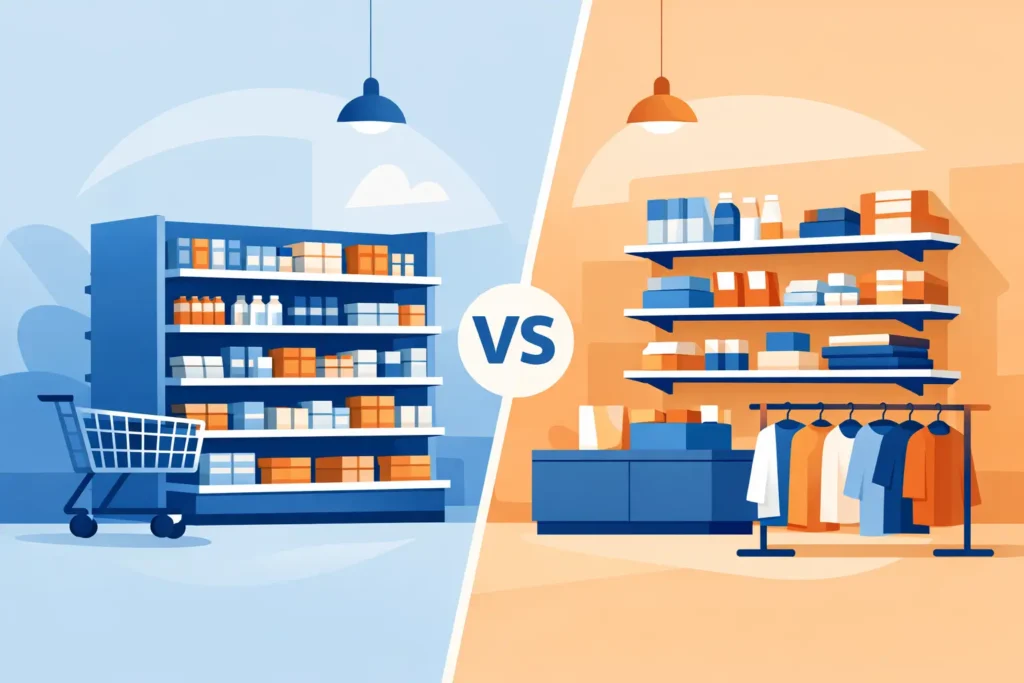
A retail fixture decision can change how customers move, what they notice, and how efficiently staff replenish stock. When comparing gondola shelving vs wall shelving, the practical question is not which system is better in general. It is which system supports your product range, store footprint, traffic flow, and merchandising plan.
Both fixture types are commercial retail essentials. Gondola shelving creates freestanding merchandising runs within the selling floor, while wall shelving uses perimeter space to carry products along the walls. Most successful supermarkets, pharmacies, convenience stores, electronics outlets, and specialty retailers use a considered mix of both. The right balance helps maximize display capacity without making the store feel crowded or difficult to shop.
Gondola Shelving vs Wall Shelving: The Core Difference
Gondola shelving is a freestanding, modular shelving system. It is commonly configured as a double-sided run with shelves on both faces, creating aisles through the center of a store. Single-sided gondola units can also be used where a freestanding display is needed without access from both sides. End bays and promotional end caps provide additional display opportunities at high-traffic points.
Wall shelving, often called wall-mounted or wall bay shelving, is installed against a perimeter wall. It typically consists of uprights, brackets, back panels, and adjustable shelves. Because customers only shop one side, wall shelving has a smaller footprint and leaves the central floor available for circulation, service counters, or gondola aisles.
The difference is straightforward: gondolas build the store plan from the floor outward, while wall shelving makes productive use of the perimeter. Their commercial value depends on how they work together.
When Gondola Shelving Is the Better Choice
Gondola shelving is the working fixture of high-volume self-service retail. It gives operators a large amount of display space within a compact area and supports logical category organization. A grocery store can dedicate full gondola runs to packaged food, household cleaning, personal care, or beverages. A pharmacy can create clear aisles by product need. An electronics retailer can use gondolas for accessories, small packaged items, and impulse purchases.
The main advantage is two-sided selling capacity. One gondola run can hold two related categories, or it can separate categories facing different aisles. This makes gondolas especially effective where the goal is to carry breadth of assortment while keeping shelves easy for shoppers to scan.
Gondolas also offer strong flexibility. Adjustable shelves allow merchandising teams to accommodate changing package sizes, seasonal product lines, or new brand plans. Accessories such as shelf dividers, ticket strips, hooks, baskets, and signage holders can make the same bay suitable for very different products. This is valuable for retailers that regularly reset departments or rotate promotions.
End caps are another major benefit. Positioned at aisle ends, they are highly visible from cross-aisles and store entrances. They can feature promotional stock, new arrivals, high-margin products, or seasonal campaigns. In a supermarket, an end cap may support a bundled offer. In a health and beauty store, it can spotlight a new product launch. These displays should be planned carefully, as poorly stocked end caps quickly lose their impact.
However, gondola systems require adequate floor space. A run that is too deep, too tall, or too closely spaced can restrict movement and reduce sightlines. This is particularly relevant in smaller convenience stores, compact pharmacies, and boutique retail environments. Gondolas should support customer flow, not create visual barriers.
When Wall Shelving Is the Better Choice
Wall shelving is often the most efficient way to increase stock capacity without consuming valuable selling-floor space. It turns perimeter walls into organized merchandise zones and is especially useful for stores with limited square footage or a narrow rectangular layout.
For many categories, wall shelving provides an ideal product backdrop. Grocery retailers can place dry goods, beverages, and household items along the walls. Electronics stores can use wall bays for boxed accessories and small appliances. Fashion and lifestyle outlets can combine shelving with hanging rails, hooks, acrylic holders, or branded display elements to create a more curated presentation.
Because wall shelving leaves the center of the store open, it helps maintain clean circulation. This can improve visibility from the entrance and make the store feel less congested. It also gives retailers a clear place for taller fixtures or bulkier inventory, provided the wall system is correctly specified and securely installed.
Wall shelving works well for products that customers browse deliberately rather than discover while walking an aisle. It can also support category zoning. For example, a convenience store may position snacks and drinks along one wall, personal care along another, and use central gondolas for everyday grocery items and promotional displays.
Its limitation is accessibility from only one side. Wall bays do not create the same selling density as double-sided gondolas, and they depend on available wall length. Doors, windows, refrigeration, service counters, electrical panels, and branding features can reduce usable perimeter space. A store with extensive glazing may need to rely more heavily on gondola fixtures to achieve required capacity.
Plan Around Shopper Flow, Not Fixture Count
The most common layout mistake is selecting fixtures based only on how many shelves they provide. Capacity matters, but a retail store must also be easy to enter, navigate, browse, replenish, and maintain.
Start by identifying the customer journey. Consider what shoppers should see first, where they will turn, which categories need repeated exposure, and where queues or congestion may form. In food retail, essential categories are often placed deeper into the store to encourage broader shopping. In specialty stores, focal walls may be used to present hero products or reinforce brand identity.
Gondola aisles should have enough width for customers, baskets, carts, and restocking activity. Narrow aisles may increase fixture density on paper, but they can create an uncomfortable customer experience and slow down operations. The appropriate clearance depends on the store format, expected traffic, local accessibility requirements, and the equipment used by staff.
Wall shelving should not become a continuous, undifferentiated line of stock. Break long runs with signage, category headers, branded panels, or display changes that help customers understand where one department ends and another begins. Good visual organization reduces the time customers spend searching for basic products.
Product Weight, Size, and Replenishment Matter
Fixture selection must reflect the physical demands of the merchandise. Lightweight cosmetics, stationery, and snack packs need a different shelf configuration from bottled beverages, bulk groceries, power tools, or boxed appliances. Shelf depth, shelf thickness, bracket type, upright spacing, and load rating all need to match the intended use.
Gondola shelving is often preferred for packaged consumer goods because it supports repeated replenishment from both sides and can be configured with multiple shelf levels. Lower shelves can hold heavier stock, while upper shelves carry lighter products or slower-moving items. This arrangement helps protect stock and makes everyday replenishment more efficient.
Wall shelving is suitable for heavy products when it is professionally installed with appropriate components and fixing methods. Buyers should never treat wall-mounted display systems as a decorative feature alone. The condition of the wall, the expected load, and the fixing specification all affect safety and long-term performance.
For both systems, shelf loading should be planned before purchase, not after installation. Overloaded shelves, uneven weight distribution, and improvised add-ons can create maintenance issues and weaken the overall presentation of the store.
Create a Stronger Merchandising Mix
A practical retail layout often uses wall shelving for core category storage and gondola shelving for aisle-based discovery. This creates more than a space-saving plan. It establishes a hierarchy between destination products, routine purchases, promotional lines, and impulse items.
For example, a small supermarket may use perimeter wall bays for beverages, cooking essentials, and cleaning products. Central gondola runs can then organize snacks, breakfast goods, canned food, and personal care. End caps can highlight promotional offers, while checkout displays handle last-minute add-on purchases.
In an electronics outlet, wall shelving may carry boxed stock and category signage, while gondolas display cables, chargers, batteries, headphones, and other accessories that benefit from frequent browsing. The fixture system should also work alongside security solutions, price communication, and branded point-of-purchase displays where required.
Color, back panels, shelf-edge labeling, and lighting should be considered as part of the overall display system. Fixtures that hold products effectively but provide weak price visibility or inconsistent category communication will not perform as well as a coordinated retail presentation.
Choose Fixtures That Support Future Changes
Retailers rarely keep the same plan forever. Product ranges expand, seasons change, promotional priorities shift, and new suppliers require different packaging formats. Modular shelving gives operators the ability to adjust shelf positions, add bays, reconfigure accessories, or extend a run as needs change.
This is where a trade-focused supplier can add value beyond the initial fixture order. The right specification considers present capacity, future expansion, replacement parts, compatible merchandising components, and the availability of consistent finishes across multiple locations. For chains and fit-out contractors, standardization is particularly important because it supports faster rollouts and a more uniform customer experience.
The best choice is often not gondola shelving or wall shelving alone. Build the perimeter with purpose, place gondolas where they improve category flow, and leave enough open space for shoppers to move comfortably. A well-planned fixture layout gives every product a place while making the entire store easier to shop and easier to operate.