
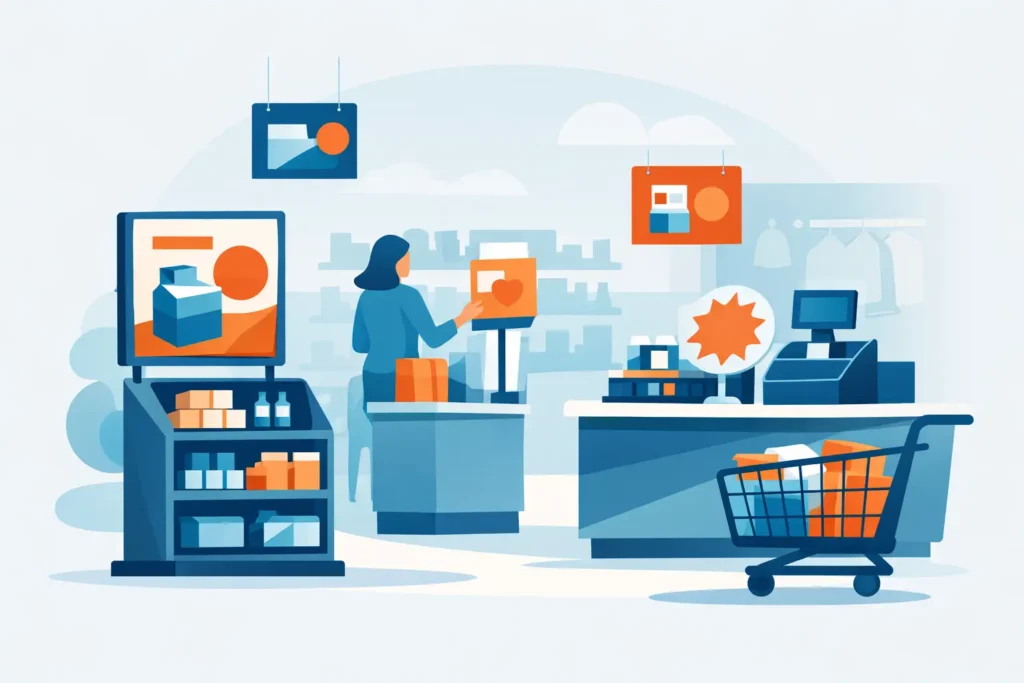
A shopper standing at the shelf has already done most of the work: entered the store, found the category, and narrowed down the options. The final decision can take only a few seconds. What is point of purchase signage? It is the signage placed where that decision happens, giving shoppers a clear reason to notice, compare, select, or add a product to their basket.
For retailers, POP signage is not simply printed marketing material. It is a practical merchandising tool that connects promotions, product information, shelf organization, and brand presentation at the point where sales are won or lost.
What Is Point of Purchase Signage?
Point of purchase signage, commonly called POP signage, is any sign, graphic, display message, or visual communication positioned near merchandise or at a transaction point to influence a purchase decision. It can appear on shelves, end caps, checkout counters, product stands, gondolas, windows, freezer doors, and freestanding promotional displays.
The term is often used alongside point of sale, or POS, signage. The two overlap, but there is a useful distinction. POP signage is generally placed throughout the selling floor, close to the product. POS signage is more specifically associated with the checkout area, where payment takes place. A counter display promoting batteries beside a cash register is a POS application. A shelf talker identifying a special offer in the battery aisle is POP signage.
In real store planning, the distinction matters less than the commercial objective: make the offer visible, easy to understand, and relevant at the right moment.
Why POP Signage Matters on the Selling Floor
Retail space is competitive. Brands compete for attention within a category, while retailers need to maintain clear navigation, tidy shelves, and promotional consistency across multiple locations. Well-planned POP signage gives each product area a stronger visual hierarchy.
It can draw attention to a new item, identify a value offer, explain a product benefit, direct shoppers toward a category, or encourage an impulse purchase. In supermarkets, this may mean highlighting a bundle offer or seasonal range. In electronics retail, it may mean comparing technical features or calling out an accessory that complements a higher-value purchase. In fashion, signage can support size navigation, collection messaging, or promotional zones without overwhelming the store design.
The strongest POP programs reduce friction. Shoppers should not have to ask staff where an item is, whether an offer applies, or why one product costs more than another. Clear messaging supports faster decisions while allowing store teams to focus on service, replenishment, and operations.
Common Types of Point of Purchase Signage
The right format depends on product type, fixture design, store traffic, and how frequently the message needs to change. Most retail environments use a combination of permanent sign holders and replaceable printed graphics.
Shelf-Level Signage
Shelf edge labels, shelf talkers, ticket holders, data strips, and promotional clips place information directly beside the product. They are especially effective in grocery, pharmacy, convenience, and hardware stores, where shoppers compare several similar items on a single shelf.
Shelf-level signage should be compact and legible. It needs to communicate the key message without covering price labels, product facings, or required product information. Acrylic holders, clear sign clips, and compatible shelf merchandising components keep the presentation organized and make promotional changes easier for store teams.
Freestanding Displays and Sign Holders
Poster stands, sign frames, floor stands, and freestanding display units give promotions greater visibility in high-traffic areas. They are commonly used at store entrances, aisle ends, promotional islands, service counters, and queue lines.
These formats suit messages that require more than a small shelf label, such as a seasonal campaign, a brand launch, or a multi-buy offer. Their value comes from placement as much as graphics. A floor stand positioned in a narrow aisle can become an obstruction; the same display at the entrance to a promotional zone can guide traffic and improve campaign awareness.
Countertop and Checkout Signage
Checkout signage is designed for short dwell time and immediate action. Small countertop sign holders, acrylic displays, price cards, and compact product stands are commonly used for snacks, gift cards, accessories, personal care items, and other low-consideration purchases.
Because shoppers are often waiting to pay, the message should be direct. A clear price, a simple offer, or one strong product benefit is usually more effective than detailed campaign copy.
Digital and Illuminated Signage
Digital displays and illuminated sign systems are useful when messages change frequently or need stronger visibility. They can support time-sensitive promotions, menu-style messaging, product demonstrations, and branded feature areas.
However, they are not automatically the best option. Digital signage requires power, content management, suitable mounting, and reliable maintenance. Illuminated signs need to work with the store’s lighting plan rather than compete with it. For a simple recurring shelf promotion, a durable printed holder may be more practical and cost-effective.
How POP Signage Influences Purchase Decisions
Effective signage works because it answers the questions shoppers ask silently at the shelf: What is this? Why should I choose it? Is there an offer? Where do I find the related product?
Price messaging is one answer, but it is not the only one. A premium product may need a benefit-led message to justify its position. A new food product may need a clear flavor cue. A high-value electronic item may require a concise feature comparison. The signage should match the decision shoppers need to make.
Visual contrast also matters. Color, size, framing, and placement help a message stand out from surrounding packaging and store fixtures. Yet high contrast should not become visual noise. When every product has a bright promotional sign, none of them receive meaningful attention. Retailers need a controlled sign system with consistent formats for price, promotion, category, and brand communication.
Choosing the Right POP Signage for Your Store
Start with the location and the action you want the shopper to take. A sign at the entrance may build awareness, while one at shelf level should support selection. A checkout message should encourage an immediate add-on purchase. Using the same sign format for all three jobs usually weakens the result.
Material choice should reflect the operating environment. Card-based signs can be economical for short campaigns. Acrylic holders, plastic frames, metal stands, and durable shelf components are better suited to frequent handling and long-term use. In food retail, signage systems should also be easy to clean and simple for staff to update during promotional changes.
Consider viewing distance before approving artwork. A message intended to be read from several feet away needs a large headline and minimal copy. Small text may be appropriate for a shelf ticket, where shoppers are already close to the product. This is a common planning error: using campaign artwork designed for a poster in a format that is too small to read.
For multi-store retailers, standardization is equally important. Common holder sizes, graphic templates, and installation methods help maintain brand consistency and reduce execution time at store level. A centralized campaign can only perform consistently when each branch has the correct display hardware and clear placement instructions.
Installation and Maintenance Are Part of the Strategy
A well-designed sign can still fail if it is bent, misplaced, outdated, or hidden by stock. POP signage should be reviewed as part of normal store walks, particularly after replenishment, price changes, and promotional resets.
Check that graphics are current, holders are clean, fixtures are stable, and sightlines remain open. Promotional signs should never block safety information, aisle access, product labels, or security equipment. In high-traffic locations, choose secure mounting methods that can withstand customer contact and routine cleaning.
Store teams also need a simple system for removing expired messages. An outdated offer damages trust quickly, especially when the price at checkout does not match the sign on the floor.
Make Every Sign Earn Its Space
The best point of purchase signage is purposeful rather than decorative. It gives shoppers useful information at a precise moment, supports a product or promotion, and fits the physical realities of the fixture and store layout.
Before adding another sign, ask what decision it will improve and where that decision occurs. With the right holders, display formats, and message hierarchy, POP signage becomes a working part of the retail environment – helping products get noticed without making the store harder to shop.