
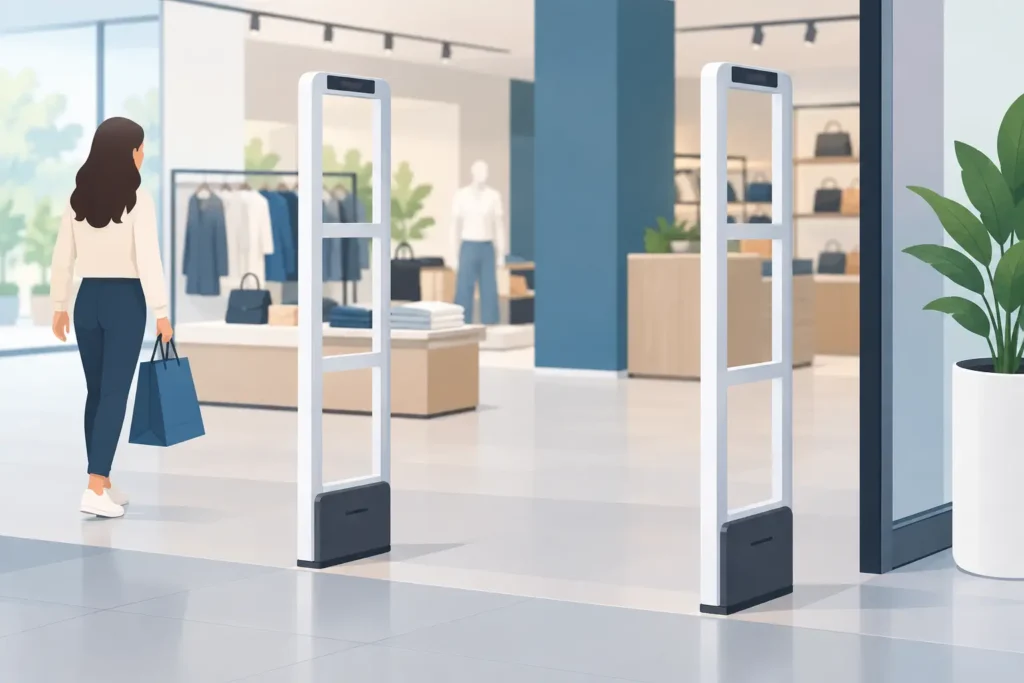
A security pedestal review should begin at the store entrance, not with a product photo or a headline detection range. Electronic article surveillance pedestals have one clear job: help retailers reduce unauthorized product removal while keeping entry and exit points professional, accessible, and easy for shoppers to use. The right system supports loss prevention without making the store feel restrictive.
For supermarkets, electronics stores, fashion outlets, pharmacies, and specialty retailers, pedestal selection affects more than shrink control. It influences checkout procedures, fixture placement, customer flow, tag purchasing, and the ongoing workload for store teams. A lower-priced system can become expensive if it causes frequent false alarms, has a narrow effective aisle, or requires tags that do not suit the merchandise.
What a Security Pedestal System Actually Includes
A security pedestal is the visible antenna positioned at an entrance or exit. It works with compatible hard tags, adhesive labels, detachers, deactivators, and, in many installations, an alarm management process. When an active tag or label passes through the detection zone, the pedestal sounds an alarm and may provide visual indication to help staff identify the direction of movement.
The pedestal itself is only one part of the system. A reliable result depends on matching the antenna technology to the tag type, store opening width, product category, and nearby equipment. This is why comparing pedestals by appearance alone is rarely useful. Two systems with similar acrylic covers or aluminum frames may perform very differently once installed in a busy retail environment.
Most retail projects use either radio frequency, commonly called RF, or acousto-magnetic, commonly called AM, technology. RF systems are widely used for apparel, boxed goods, cosmetics, and general retail because tags and labels are available in many practical formats. AM systems are often selected where dependable detection of certain tag types is required or where a retailer has already standardized its loss prevention program around AM labels and hard tags.
Neither technology is automatically better for every site. The best choice is the one that matches the retailer’s tagging process, merchandise, entrance conditions, and long-term replenishment requirements.
Security Pedestal Review: The Criteria That Matter
A trade-focused security pedestal review should assess operational performance before cosmetic finish. Retailers should ask what the system can detect consistently in their actual doorway, not only under ideal demonstration conditions.
Detection width and real-world coverage
Detection width is often the first specification buyers compare, but it needs context. A wider gap between pedestals can improve shopper access and accommodate carts, baskets, strollers, or mobility devices. However, a wide opening may require stronger equipment, specific tag formats, or additional antennas to maintain reliable performance.
The usable aisle width should be planned around the actual entrance. Consider door frames, anti-slip mats, promotional displays, queue barriers, shopping baskets, and nearby shelving. A pedestal installed too close to metal fixtures, electrical equipment, or dense product displays can experience interference or reduced consistency.
For a narrow boutique entrance, a compact single-aisle configuration may be sufficient. A supermarket or high-volume department store may need multiple pedestals and clearly planned lanes to cover wider traffic flow. Trying to stretch one system across an opening beyond its recommended configuration creates a security gap that is difficult to recover later.
Tag and label compatibility
A pedestal is only effective when its tags and labels fit the merchandise and the store’s daily routines. Clothing retailers may require reusable hard tags in several pin types for delicate fabrics, shoes, handbags, and packaged accessories. Electronics retailers may need safer tagging options for boxed items, display products, and high-value accessories. Grocery and pharmacy operators frequently depend on discreet labels that can be applied quickly to selected high-risk goods.
Ask whether the proposed system supports the tag formats your team will use most often. Also consider detaching and deactivation at checkout. Staff should be able to remove or deactivate protection without slowing transactions or damaging packaging. If tags are difficult to apply, easy to defeat, or incompatible with the merchandise, compliance drops quickly.
Alarm quality and false-alarm control
An alarm is useful only when employees trust it. Excessive false alarms create poor customer experiences and encourage staff to ignore alerts. In contrast, an alarm system that rarely activates when tagged merchandise leaves the store does not provide meaningful protection.
False alarms can result from poor installation, incompatible tags, environmental interference, inactive labels that were not properly deactivated, or nearby security systems. During system evaluation, request a site assessment that identifies potential interference sources and confirms how the equipment will be calibrated after installation.
Sound and light indicators should also suit the retail environment. A busy supermarket may need a clear alarm that can be recognized over ambient noise. A premium fashion store may prefer a more discreet visual approach while still giving staff enough notice to respond. The objective is not to create confrontation. It is to give trained employees a timely opportunity to check the transaction or assist the customer.
Pedestal construction and store presentation
Security equipment sits at one of the most visible points in the store. Its construction should be durable enough for carts, bags, frequent cleaning, and daily foot traffic, while its finish should complement the retail environment.
Clear acrylic pedestals can reduce visual obstruction in boutique and specialty settings. Metal-framed or enclosed models can suit high-traffic entrances where impact resistance and a more defined security presence are priorities. Slim profiles work well where space is limited, but they should not be selected at the expense of the required detection coverage.
For multi-location retailers, standardizing pedestal style can strengthen a consistent store presentation. It also simplifies training, replacement planning, and the ordering of compatible consumables.
Installation Is Part of Product Performance
A well-specified pedestal can underperform if the installation is treated as an afterthought. Before finalizing a system, review the entrance plan, power availability, flooring, cable routes, ceiling conditions, nearby metalwork, and adjacent point-of-sale equipment.
In new store projects, security pedestals should be included early in the fit-out drawing. This allows contractors to prepare power and conceal cables where appropriate, rather than adding visible trunking after the floor and entrance finishes are complete. For existing stores, installation planning should minimize disruption while protecting customer access and emergency egress.
Pedestal positioning also needs to work with the wider loss prevention plan. A system placed far from checkout may require different staff response procedures than one visible from the cash wrap. Sightlines matter. Employees must be able to see the entrance, respond safely, and distinguish between a genuine alarm and a tag that was missed during checkout.
Choosing by Retail Category
Retail format changes the correct specification. Fashion retailers usually prioritize reusable hard tags, a clean entrance appearance, and a process that keeps fitting-room and checkout teams efficient. Electronics stores often need targeted protection for premium accessories, boxed products, and display merchandise, with a layout that does not block customers carrying larger purchases.
Supermarkets and grocery stores face different conditions: wider entrances, carts, high transaction volumes, promotional end caps, and a mix of product sizes. Pedestal selection must account for customer flow and the practical application of labels to commonly targeted goods. Pharmacies and health-and-beauty retailers may focus on small, high-value items that require discreet labels and consistent deactivation at the register.
This is where a single-source supplier can add value. JS Retail Displays helps commercial buyers evaluate security systems alongside store fixtures, signage, and merchandising needs, so entrance protection is considered as part of the complete retail environment rather than a separate purchase.
Questions to Ask Before Ordering
Before approving a security pedestal system, buyers should confirm the technology, aisle configuration, compatible tag range, and expected operating conditions. They should also establish who will install and commission the equipment, what staff training is included, and how replacement tags, labels, detachers, and service support will be handled.
It is equally useful to define success in measurable terms. That may include fewer incidents involving selected product groups, better visibility at the entrance, fewer unexplained alarms, or smoother checkout handling of protected merchandise. A pedestal system should be reviewed after launch using those practical outcomes, not only whether the alarm sounds during a test.
The strongest choice is usually the one that fits the store’s entrance, merchandise, staff workflow, and future expansion plans. When those details are addressed before installation, security pedestals become a dependable part of store operations rather than a highly visible fixture that staff and shoppers learn to work around.