
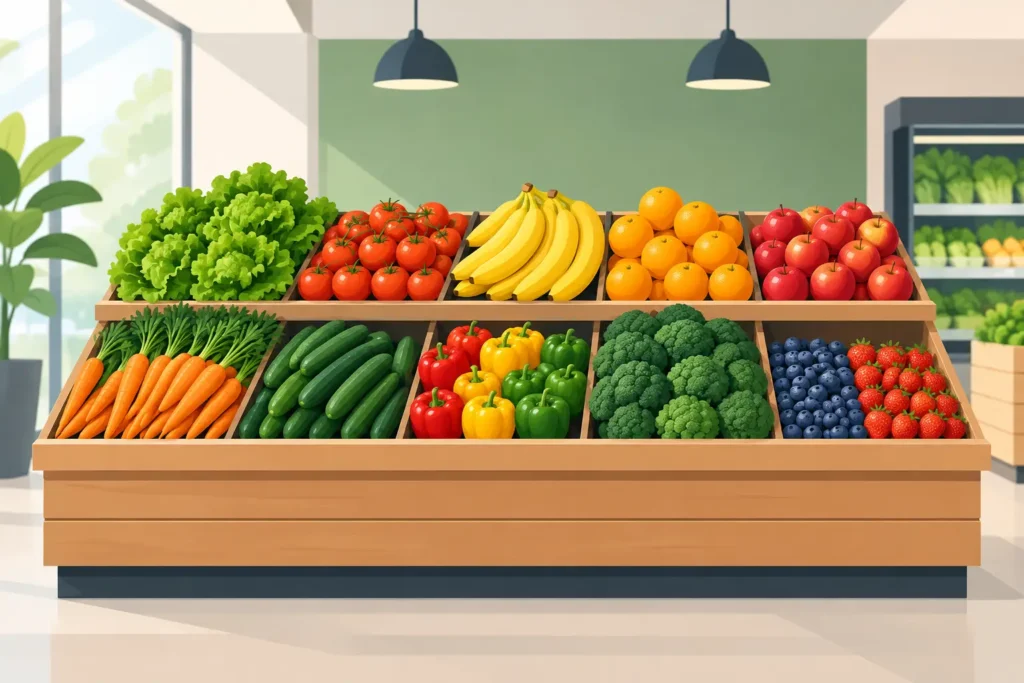
Fresh produce can make a grocery department look abundant and profitable, or neglected within hours. Knowing how to display fresh produce means balancing visual volume with product care: shoppers should see color, freshness, and choice, while staff can rotate stock quickly and protect delicate items from damage.
For supermarkets, neighborhood grocers, and food retail projects, the produce department is often the first signal of overall store quality. The right fixtures, layout, and merchandising standards turn that signal into stronger shopper confidence, higher basket value, and lower shrink.
Start With a Produce Layout That Supports Traffic
A produce department needs a clear customer path before it needs decorative presentation. Position high-impact seasonal items, colorful fruits, and promotional displays where shoppers first enter the area. This creates an immediate fresh-market impression and gives customers an easy reason to stop.
Build the main run around everyday essentials such as bananas, tomatoes, onions, potatoes, apples, and citrus. These lines require dependable capacity and frequent replenishment, so they should sit in accessible locations with adequate backstock support. Specialty, premium, and organic produce can then be grouped in clear zones rather than scattered across the department.
Keep aisles wide enough for shopping carts, stock trolleys, and staff movement. A display that looks attractive on a plan but blocks replenishment will quickly become untidy during peak trading. For smaller stores, use wall-based produce shelving to preserve central floor space, then add compact island displays only where customer circulation allows.
Choose Fixtures by Product Type, Not Appearance Alone
When planning how to display fresh produce, fixture selection should begin with product behavior. Produce has different weights, bruising risks, temperature needs, and replenishment cycles. One display style rarely suits every line.
Sloped produce tables and tiered bins work well for apples, citrus, potatoes, onions, and other sturdy products that benefit from strong visibility. The incline brings product toward the shopper and helps maintain a full appearance without forcing customers to reach into deep containers.
For delicate products, shallow trays are the better choice. Berries, stone fruit, tomatoes, mushrooms, and soft avocados can be damaged when piled too high. Use divided crates, shallow baskets, or tray-based shelving to control depth and make rotation easier.
Leafy greens, herbs, and other chilled lines need suitable refrigeration or proximity to refrigerated cases. Dry ambient fixtures may still be used for short-term promotional presentation, but the merchandising plan must protect product quality. A visually impressive display loses value if it increases wilt, spoilage, or markdowns.
Commercial-grade fixtures should also be selected for practical maintenance. Powder-coated steel frames, food-safe bins, washable baskets, adjustable shelving, and replaceable components help operators keep the department hygienic and consistent across multiple locations.
Use Color Blocking and Height to Create Impact
Customers judge freshness before they touch a product. Color blocking makes the department easier to shop and gives the display a more intentional appearance. Group red, green, yellow, orange, and purple items in neighboring sections, while avoiding arrangements that make bruised or overripe stock more visible.
A useful approach is to create a strong color statement at the front of the department, then transition into practical categories. For example, citrus, apples, peppers, and grapes can provide visual impact, while potatoes, onions, and root vegetables form the dependable volume section further along the route.
Height matters, but excessive stacking is a common mistake. Use tiered displays to create a stepped profile, with the tallest or most durable lines placed at higher levels. Keep fragile produce lower and easy to inspect. Shoppers should be able to view product labels, assess condition, and select an item without disturbing the entire display.
Avoid filling every surface to the same level. Small changes in elevation, crate orientation, and tray depth create definition. The goal is a market-style sense of abundance that still looks controlled and easy to shop.
Build for Rotation, Replenishment, and Reduced Waste
A produce display is an operating system, not a static installation. Fixtures must allow staff to replenish quickly, remove poor-quality items, and follow first-in, first-out rotation throughout the day.
Use modular bins and removable trays where possible. These let staff lift a full section for cleaning or rotation instead of handling every item individually. Angled shelves and front-loading bins can also improve access, provided they do not cause product to roll, bruise, or collect in hard-to-reach areas.
Do not overfill displays at opening simply to create volume. Heavy stacking can damage product, hide aging stock, and make rotation difficult later in the day. It is usually more efficient to present a well-faced display and replenish in smaller, planned quantities. This is especially true for berries, bagged salads, herbs, and soft fruit.
Separate products that create different handling challenges. Wet produce should not sit where drainage creates slippery floors or affects packaging. Loose soil from root vegetables should be contained away from ready-to-eat items. Produce with strong odors should not dominate delicate neighboring lines.
Ethylene sensitivity also deserves attention. Apples, bananas, tomatoes, and avocados can speed ripening in nearby sensitive products. Exact placement depends on stockholding time, refrigeration, and store routines, but managers should account for compatibility when assigning permanent display positions.
Make Pricing and Signage Easy to Read
Clear pricing converts visual interest into a purchase. Every produce display needs legible, consistent price communication at the point of selection. Shoppers should not need to search for a matching shelf label or ask staff to confirm whether an item is sold by weight, unit, pack, or promotion.
Use shelf-edge ticket holders, sign frames, chalkboard-style inserts, or poster holders that match the department format. Larger signs can support promotional bins and seasonal themes, while smaller labels keep everyday lines organized. Include product name, origin where relevant, unit of sale, and price in a clear hierarchy.
Good signage can also help customers choose unfamiliar products. A short use cue such as “ideal for grilling,” “ready to eat,” or “great for juicing” gives premium and specialty lines a practical reason to enter the basket. Keep this information concise. In produce retail, the product should remain the visual focus.
Balance Bulk Displays With Packaged Produce
Bulk produce communicates freshness and choice, but packaged lines offer speed, portion control, and a cleaner handling experience. The right mix depends on customer habits, available labor, local regulations, and the product category.
Use bulk displays for high-turnover staples and products shoppers prefer to inspect individually. Packaged produce is often better for berries, salad mixes, herbs, pre-cut fruit, grapes, and convenience-led items. Group packs in clearly defined refrigerated or ambient zones so shoppers can compare sizes and prices without confusion.
A strong department gives each format adequate space. If packaged products are squeezed beside loose stock without clear boundaries, the result can look cluttered and make inventory control harder. Dividers, trays, and dedicated shelving maintain order while allowing each format to perform its role.
Maintain the Display Throughout Trading Hours
The best fixture cannot compensate for weak daily standards. Produce displays need scheduled checks for damaged items, empty sections, mixed varieties, spilled leaves, inaccurate signs, and poor facing. High-traffic periods may require attention every 30 to 60 minutes.
Cleaning should be built into the display plan. Select materials that can be wiped down quickly and avoid designs with unnecessary gaps where debris accumulates. Replace worn baskets, cracked trays, faded labels, and damaged ticket holders before they affect the department’s appearance.
Lighting should support accurate color without generating excessive heat. Bright, even illumination helps customers judge ripeness and quality, while harsh lighting can make produce look washed out or create distracting glare on packaged items. Test lighting from the shopper’s viewpoint, not only from the aisle entrance.
For new stores, refits, and multi-site rollouts, JS Retail Displays can help specify produce fixtures, merchandising components, and signage systems that suit the available space and operating model. The most effective installation is one that looks full at opening, remains easy to maintain at peak hours, and still protects product quality at close.